



Enhancing wheat productivity with Nando Technology
Updated: Aug 27
How Lithuanian Farmers are Adding €370/ha to Wheat Revenue with Biostimulants
Every season, wheat farmers face a complex set of challenges: how to push yields higher and improve profitability while navigating volatile grain prices and the skyrocketing cost of conventional inputs. Beyond these market pressures, farmers are also adapting to increasing regulatory standards under the EU Green Deal and the long-term challenge of maintaining soil health for future generations. The traditional model of simply applying more synthetic fertilizer is reaching its economic and ecological limits.

But what if there was a way to work with nature to unlock the hidden potential in your soil and your crop? A new generation of microbial-based biostimulants from Nando is demonstrating that this isn't just a possibility—it's a profitable reality.
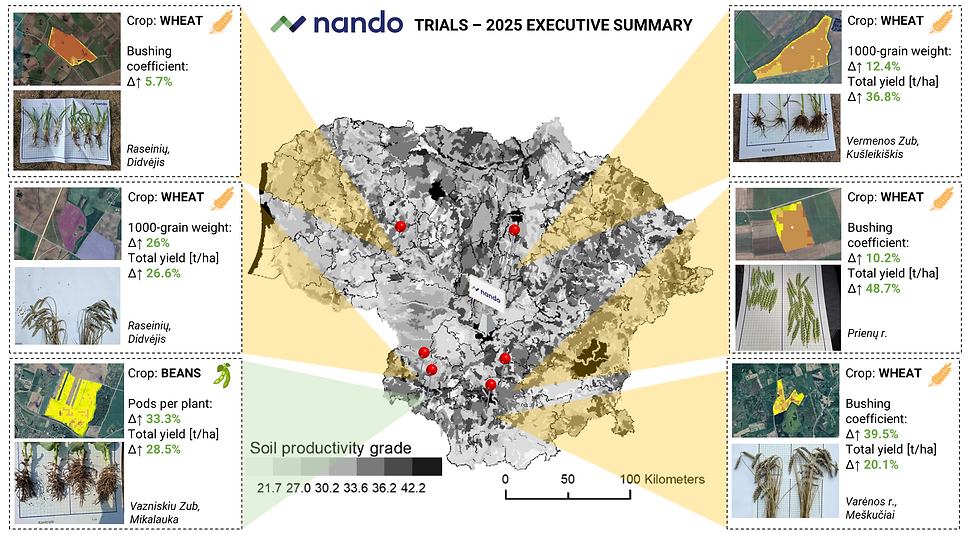
The Proof is in the Yield: A 27% Gain in Marijampolė
In the fertile fields of the Marijampolė region, a recent evaluation has turned heads, showcasing the powerful return on investment that biostimulants can deliver. By integrating Nando's microbial technology into their wheat program, farmers achieved a staggering 27% average yield increase.
This isn't just an impressive agronomic result; it's a significant financial win.
From Tonnes to Euros: Calculating the Revenue Gain
Translating yield into revenue requires a clear look at the numbers. Based on current, conservative market data for the region, the financial impact is undeniable.
Key Assumptions:
Average Baseline Yield: 6.5 tonnes per hectare (t/ha)
Market Wheat Price: €210 per tonne
The Calculation:
Additional Yield per Hectare:
6.5 t/ha (Baseline) × 27% (Gain) = +1.755 tonnes per hectare
Additional Revenue per Hectare:
1.755 t/ha × €210/t = ~€370 per hectare in gross revenue gain
For a farmer managing 100 hectares of wheat, this translates to a potential €37,000 increase in revenue. This impressive figure highlights a significant Return on Investment (ROI), demonstrating that investing in soil and plant biology can be one of the most profitable decisions a farmer makes.
The Science of Success: A Season-Long Microbial Strategy
This isn't magic; it's microbiology. These results are achieved by using targeted biostimulants that boost the plant's natural processes, improve nutrient efficiency, and build resilience.
1. Powering Growth & Nitrogen Supply with BioN
Conventional nitrogen fertilizers, produced via the energy-intensive Haber-Bosch process, are not only costly but can also be prone to leaching and volatilization, leading to waste and environmental concerns. BioN introduces elite strains of nitrogen-fixing bacteria that form a close relationship with the plant. These microbes convert atmospheric nitrogen (N₂) gas—an abundant and free resource—into plant-available ammonia (NH₃), providing a continuous, supplemental nitrogen source directly where it's needed. This ensures robust development and crucial nitrogen availability during the critical grain-fill period, leading to higher yields and improved protein content.
2. Unlocking Soil Nutrients with BioNPK Powder S
A significant portion of phosphorus (P) and potassium (K) applied as fertilizer, or already present in the soil, is often chemically bound to soil minerals (like calcium or aluminum), rendering it unavailable to the plant. BioNPK Powder S contains a powerful blend of microbes that specialize in breaking these chemical bonds. They produce organic acids and enzymes that solubilize phosphate and mobilize potassium, transforming your soil's legacy nutrient bank into an active resource. This "unlocking" effect ensures your crop has access to the P needed for energy transfer (ATP) and the K required for water regulation and stalk strength, especially during its most demanding growth phases.
Beyond the Harvest: Investing in Your Soil with BIOtero
A truly sustainable strategy doesn't end at harvest. High-carbon wheat straw (with a C:N ratio of about 80:1) requires significant nitrogen for decomposition. This can cause soil microbes to temporarily immobilize, or "rob," nitrogen from the soil, making it unavailable for the next cash crop.
BIOtero is a post-harvest biostimulant designed to tackle this challenge. Its microbial consortium is specifically selected to efficiently break down tough cellulose and lignin. By accelerating straw mineralization, it mitigates this "nitrogen drag," cycling nutrients faster and ensuring a smoother transition and better start for the following crop. It turns crop residue from a problem into a valuable nutrient source.
The Future is Biological
The results from Marijampolė are a clear signal of the shift happening in modern agriculture. By integrating Nando's advanced microbial biostimulants, farmers are not just adding yield; they are building more resilient, efficient, and profitable operations from the ground up.
Ready to unlock the biological potential of your farm? Contact your local Nando's agronomy expert today to build a strategy for your 2026 wheat season
