



Efficient preparation for the new sowing season
Soil health and quality are becoming increasingly relevant topics for scientists, agronomists, and farmers. Soil is a dynamic organism, and proper care and preparation are crucial to ensure plants receive sufficient nutrients.
Key aspects to address
Decomposition of plant residues (straw and roots)
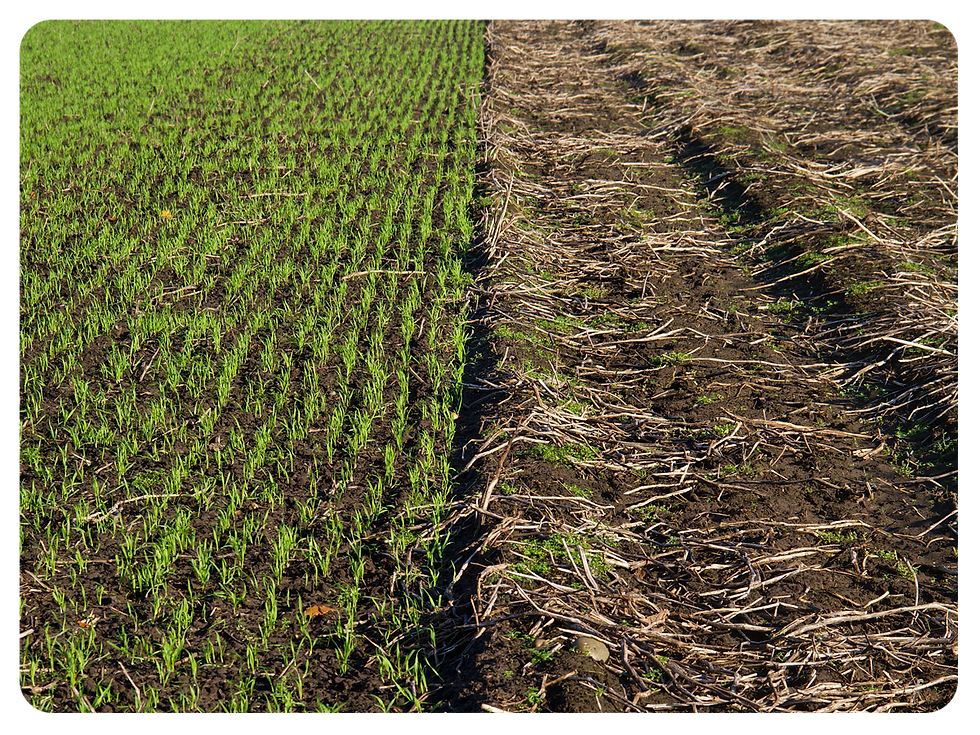
Plant residues left after harvest can become a significant obstacle to sowing if not properly decomposed. Straw, stubble, and roots are natural organic materials rich in carbon, nitrogen, and other vital nutrients. When properly processed and left in the field, they can significantly improve soil quality and fertility.
Plant residue accumulation not only traps valuable nutrients but can also cause problems, such as hindering seed germination, promoting pests and disease spread, and contributing to soil erosion. Therefore, it is recommended to chop straw immediately after harvest, spread it evenly, and incorporate it shallowly into the upper soil layer. Close contact between the residue and the soil ensures proper moisture, aeration, and access for microorganisms to intensively break down the material.
Challenges arise when the volume of plant residues is too large to incorporate evenly into the soil, leaving some on the surface. In such cases, microbiological preparations are particularly effective for accelerating the mineralization of plant residues. These preparations contain specific microorganisms that efficiently break down lignin, cellulose, and other organic materials, converting them into nutrients more easily absorbed by plants.
Seed preparation
The preparation of the seedbed and ensuring plant nutrition are critical factors determining successful plant growth and yield. The seedbed is a vital part of sowing because its quality influences seed germination and seedling development. A properly prepared seedbed ensures good seed-to-soil contact, optimal moisture, and aeration. Successful germination also requires optimal soil pH and the availability of essential nutrients.
Another important factor is seed treatment. This involves the use of fungicides and microorganisms to ensure healthy and strong plant growth. Fungicide-based seed treatment is a widely used and effective method for combating fungal diseases, such as seed mold, root rot, and seed-borne pathogens. The use of microorganisms for seed treatment is a biologically sustainable and increasingly popular approach due to its eco-friendliness. Microorganisms (e.g., nitrogen-fixing bacteria, phosphorus-solubilizing bacteria, Trichoderma, etc.) release organic acids and phytohormones that improve seed germination, root growth, early nutrition, and uniform crop emergence.
Early nutrition
Early plant nutrition is crucial for successful plant development. At this stage, plants must receive sufficient nutrients to grow and develop robustly. Here are a few methods to ensure early nutrition:
Primary fertilization: Supplies plants with essential nutrients like nitrogen, phosphorus, and potassium.
Biological additives: Activate soil microorganisms, helping plants absorb nutrients.
Stimulating root and root hair growth ensures better absorption of nutrients and water. For this purpose, it is recommended to use:
Biostimulants: Promote root growth and development, enhancing the plant's ability to absorb nutrients.
Mycorrhizal fungi: Form symbiotic relationships with plant roots, increasing their surface area and improving nutrient uptake.
Ensuring nutrient availability in soil
The availability of nutrients in the soil is critical for plant growth. Here are some ways to ensure nutrient accessibility:
Regulating soil pH: An optimal soil pH (6.5–7) supports root and root hair development, promotes beneficial microorganism activity, and minimizes nutrient lock-up in the soil.
Organic materials: Compost and other organic materials improve soil structure and nutrient availability.
Micronutrients: Supplementing with micronutrients (e.g., zinc, manganese) ensures plants receive all necessary elements.
Resistance to biotic and abiotic stress
Plants face various biotic (e.g., diseases, pests) and abiotic (e.g., drought, frost) stress factors. To enhance plant resistance, it is recommended to:
Select resistant varieties: Choose those that are resistant to major diseases and pests.
Use biological control methods: Use biological agents such as beneficial insects or biopesticides to combat pests and diseases.
Apply stress-reducing agents: Biostimulants and other tools help plants overcome stress, improving their resilience to unfavorable conditions.
Conclusions
Efficient preparation for the new sowing season requires an integrated approach that includes plant residue decomposition, seed and seedbed preparation, early plant nutrition, microorganism activation, and pH optimization. It can be confidently stated that effective seedbed preparation, early nutrition, root stimulation, nutrient availability, and stress resistance enhancement are critical factors for plant establishment, development, and yield success. By implementing these recommendations, crop health and productivity can be ensured.
